Native Venomous Neighbors:
- Jessica Broda
- Apr 1
- 5 min read
Updated: Apr 25
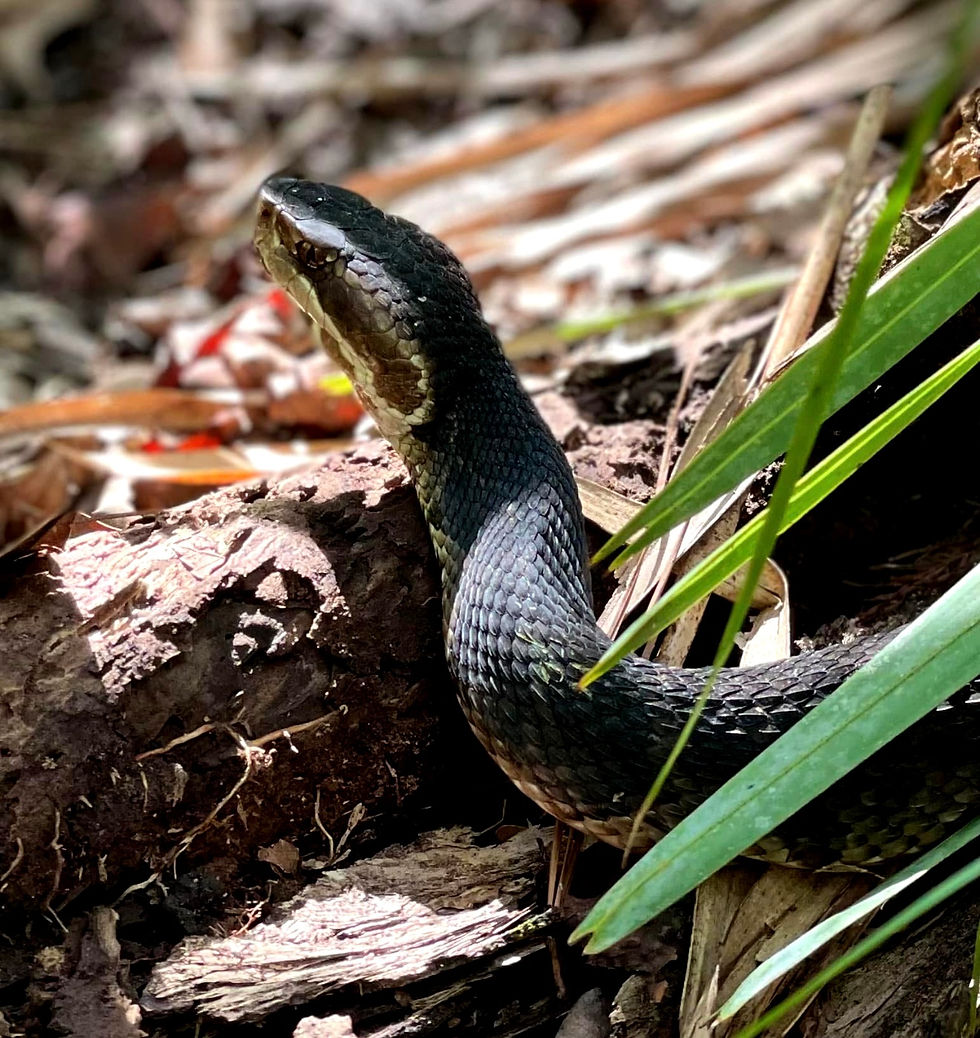
Photo by Shasta Tshoukis, used with permission
Seeing a snake can definitely be unsettling, however, the most important advice to keep in mind that they are not out looking for people. In fact, they are likely much more terrified of humans. The majority of bites happen when accidentally stepped on and from inexperienced people attempting to trap or kill them. The safest reaction is remain calm, back away slowly, and give the snake room to escape. According to a twenty-year study through University of Florida, 77.8% of snakebites occurred in adult men while they were handling wild snakes, untrained (Hagmaier, 2025).
When people hear the word snake, (especially new residents of Florida), it often triggers a stress response that leads straight to intense fear. But in reality, the majority of the snakes found around Nocatee are harmless, and play an important role to balance our local ecosystem by helping control rodents and other pests. Without snakes, our areas would be overrun with rodents and harmful insects. The consequences include crops and housing being destroyed, and a number of dangerous pathogens can be easily spread from rodents to the human population. Snakes are a major player in protecting human health. Learning to recognize Florida’s venomous snakes can help replace fear with knowledge, empowerment, and awareness. By learning the basics, new residents often feel much more prepared when living so close to nature. Florida has six native venomous snake species statewide, but in Northeast Florida, there are only three species that you are most likely to encounter. These include the Cottonmouth (also called a water Mocassin), the Dusky Pygmy rattlesnake, and the Eastern Diamondback rattlesnake. There is also mention of Coral Snakes, however, this would be incredibly rare finding. The other venomous Florida species include both the Copperhead and Timber rattlesnakes, which are typically found closer to the middle of the state and the Panhandle. Let’s go through the three venomous snakes you may encounter in our area:
1. Cottonmouth aka Water Mocassin (Agkistrodon piscivorus)
The Cottonmouth, also known as a Water Moccasin, is a large, heavy-bodied pit viper measuring 24–48 inches in length. They have a thick body with a wide triangular head (contrary to popular belief, it is a myth that you can tell if a snake is venomous based on that feature alone). They are usually found near shallow bodies of water such as marshlands, lakes, and man-made retention ponds. Because Nocatee has so many drainage areas, marsh edges, and wetland habitats, this can be a commonly sighted snake. Cottonmouths are often dark in color, ranging from black to auburn colors. While they look intimidating, like all snakes, they are very fearful of people and try their best to avoid contact. If confronted or threatened directly, they will often stand their ground and display a defensive posture that includes coiling, vibrating their tail, and opening their mouth to reveal their white oral lining which is how earned their name “cottonmouths”. Research indicates that cottonmouths rarely bite unless stepped on or picked up (University of Georgia, Savannah River Ecology Laboratory, n.d.). A non-venomous snake commonly misidentified as a cottonmouth is the Florida Banded banded Watersnake. While it may resemble a cottonmouth at first glance, the banded water-snake is typically slimmer with a less blocky head.

Photo by Ayla Babanikos, UF Thompson Earth Systems Institute
Florida Cottonmouth (Agkistrodon piscivorus)

Photo by Shasta Tshoukis,used with permission
2.Dusky Pygmy rattlesnake (sistrurus miliarius)
The Dusky Pygmy rattlesnake is another pit viper, and also one of the most common venomous snakes encountered around Nocatee. Pygmy Rattlesnakes are the smallest rattlesnakes in the U.S., averaging 16-24 inches in length, and its size makes it easy to overlook. Adults are often less than two feet, and found in flatwoods, brushy areas, and around neighborhoods that border their natural habitats. Due to the heavy development new housing in Nocatee, they are often displaced and may appear on mulch beds, and near the edges of yards along the preserves. Residents occasionally find babies displaced, and curled up on concrete pavers, in garden mulch beds, and tiny nooks around house foundations. Their tiny rattle can be very hard to hear, especially under palmettos, mulch, logs, or thick vegetation. Occasionally, people overlook them step on them, which can lead to a defensive bite, typically when barefoot. Dogs have a higher bite risk due to their natural curiosity, and the very small size of the snake. According to the University of Georgia, Savannah River Ecology website, there has never been a documented human death from Dusky Pygmy rattlesnake bite. Because of their small size, they typically deliver less venom than the larger rattlesnakes species.
Note the size differences of neonate Pygmies compared to adults:
Juvenile Dusky Pygmy rattlesnake

Photo by Shasta Tsoukias, used with permission
Adult Dusky Pygmy Rattlesnake

Photo by Shasta Tsoukias, used with permission
3.Eastern Diamondback rattlesnake (Crotalus adamanteus)
The Eastern Diamondback is the largest and heaviest rattlesnake species in the world. They typically measure between 3-6 feet in length, and are also in the same pit-viper family. Eastern Diamondbacks are often found among wooded areas, especially in our long leaf pine ecosystems. They are usually coiled beside logs and large piles of brush. Interestingly, they often share animal burrows for habitats. One example of a shared habitat with the local Gopher Tortoises in their dune burrows. Eastern Diamondbacks have experienced large population declines in recent years. Overdevelopment in Nocatee has lead to frequent displacement of these snakes which causes them to unintentionally end up among residential areas. The University of Georgia, Savannah River Ecology division stressed that “Changing public attitudes toward rattlesnakes is essential to the conservation of this species, as fear and misunderstanding often lead to snakes being killed during encounters”(University of Georgia, Savannah River Ecology Laboratory, n.d.).
Eastern Diamondback Rattlesnake

Photo by Shasta Tsoukias, used with permission
Honorable Mention: Eastern Coral snake (Micrurus fulvius)
The Eastern Coral snake is typically small to medium in size, measuring on average about 2 to 3 feet in length. Spotting an Eastern Coral snake within Nocatee is very rare. Eastern Coral snakes are very reclusive, spending most of their time underground or in brush, unless heavy rainfall over saturate the soil and they are flooded out to the surface. Despite their potency, coral snakes are not aggressive, difficult to access, and typically are only accounted for a few bites annually. They are reluctant to bite unless intentionally threatened, handled or stepped on. A review of Florida cases reported that most victims who were envenomated were bitten on their hands or upper extremities while trying to kill or hold the snake.
This snake’s identity is very controversial. The typical colors are red, yellow, and black banding, similar with the non-venomous scarlet king snakes which are much more common in Nocatee. Many rhymes have circulated, such as, “Red touch yellow, kill a fellow; red touch black, friend of Jack.” Oftentimes, confusion of the colors, which leads to many unnecessary killings of harmless Scarlet and Scarlet King snakes. Shasta Tsoukias, herpetology expert, shared the easiest way to identify a Coral Snake:
1-Coral snakes usually have black heads.
2-The tail and head are only 2 color patterns, commonly black and yellow.
It is important to point out that these identification features are specific to North America only!
Eastern Coral snake

Photo by Shasta Tsoukias,used with permission
References:
Hagmaier, D. (2025, March 10). Study: Lessons learned from 20 years of snakebites. UF Health, University of Florida.
UF Thompson Earth Systems Institute. (n.d.). Ayla Babanikos. Florida Museum of Natural History. https://www.floridamuseum.ufl.edu/earth-systems/ayla-babanikos/
lUniversity of Georgia, Savannah River Ecology Laboratory. (n.d.). Cottonmouth / water moccasin (Agkistrodon piscivorus) – venomous. https://srelherp.uga.edu/snakes/cottonmouth-water-moccasin/
Very good information regarding snakes in NE Florida and Nocatee.